Skip to main content
Contents Dark Mode Prev Up Next \(\newcommand{\N}{\mathbb N} \newcommand{\Z}{\mathbb Z} \newcommand{\Q}{\mathbb Q} \newcommand{\R}{\mathbb R}
\newcommand{\lt}{<}
\newcommand{\gt}{>}
\newcommand{\amp}{&}
\definecolor{fillinmathshade}{gray}{0.9}
\newcommand{\fillinmath}[1]{\mathchoice{\colorbox{fillinmathshade}{$\displaystyle \phantom{\,#1\,}$}}{\colorbox{fillinmathshade}{$\textstyle \phantom{\,#1\,}$}}{\colorbox{fillinmathshade}{$\scriptstyle \phantom{\,#1\,}$}}{\colorbox{fillinmathshade}{$\scriptscriptstyle\phantom{\,#1\,}$}}}
\)
Section 1.4 Increasing and Decreasing
In this section, we will look at graphs to determine where a function is increasing or decreasing. We will also learn how to identify the intervals where a function is increasing or decreasing.
Exercises Read-Watch-Try
1.
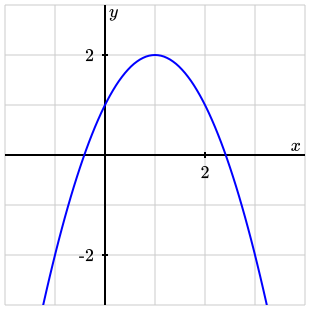
The graph of the function
\(g(x)\) is shown below. On what interval or intervals is
\(g(x)\) increasing?
\((1, \infty)\)
\((-\infty, 1)\)
\([1, \infty)\)
\((-\infty, 1]\)
2.
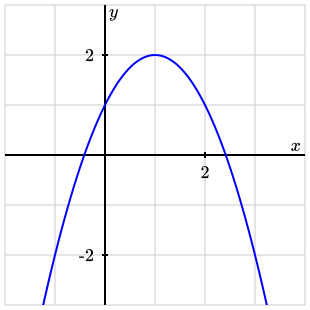
The graph of the function
\(g(x)\) is shown below. On what interval or intervals is
\(g(x)\) decreasing?
\((1, \infty)\)
\((-\infty, 1)\)
\([1, \infty)\)
\((-\infty, 1]\)
3.
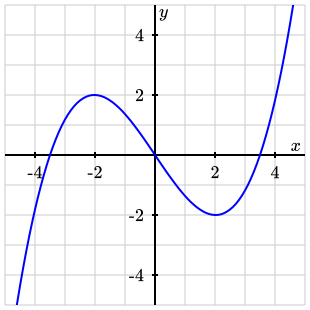
The graph of the function
\(f(x)\) is shown below. On what interval or intervals is
\(g(x)\) increasing?
4.
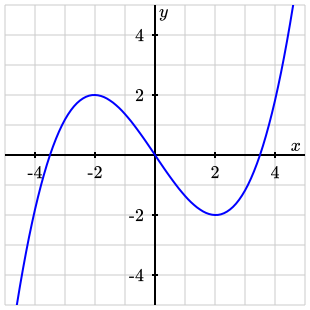
The graph of the function
\(f(x)\) is shown below. On what interval or intervals is
\(g(x)\) decreasing?