Section 8.1 Long-Run Behavior of Rational Functions
In this section, we will concern ourselves with the long-run behavior of rational functions.
Consider the graph of the function
\begin{equation*}
f(x)=\frac{2x(x+1)}{(x+2)(x-1)}
\end{equation*}
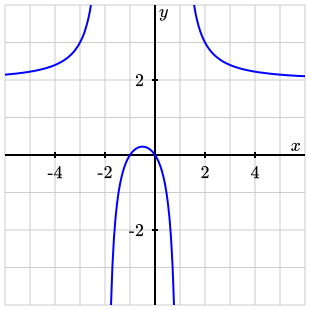
Just like with polynomial functions, we can imagine zooming way out on the graph, and we want a way to describe what the far left and far right ends of the graph are doing.
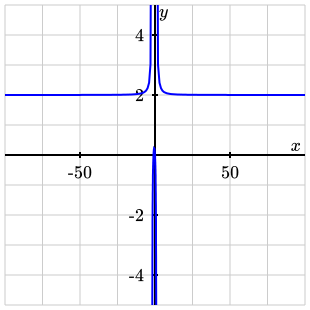
This shows us that, when our \(x\)-values become very large and negative, our \(y\)-values become very close to \(2\text{,}\) and when our \(x\)-values become very large and positive, our \(y\)-values become very close to \(2\) as well.
Using our symbolic end behavior notation, we can write this as
\begin{equation*}
\text{As } x \rightarrow -\infty, f(x) \rightarrow 2
\end{equation*}
and
\begin{equation*}
\text{As } x \rightarrow \infty, f(x) \rightarrow 2.
\end{equation*}
But why does this happen? Let’s revisit our function’s equation:
\begin{equation*}
f(x)=\frac{2x(x+1)}{(x+2)(x-1)}
\end{equation*}
If we multiply out the numerator and the denominator of the function, we can rewrite the function as
\begin{equation*}
f(x)=\frac{2x^2+2x}{x^2+x-2}
\end{equation*}

